Wednesday, 12 August 2015

A New Standard

I'm pretty sure that I have an audience of two. They being myself and some computer in the Ukrane, according to my Blogger stats. From this, I can assume that not many will read about this. However...

Last week I received my Eureka 50 class. Just like a kid with a new toy, I raced home from work to play with it. After picking it up from my local post office, I took it straight to my local hobby shop in  Hornsby (Hobbyland) to buy a chip (and thanks to Ian for putting it in) before heading home to give it a few laps of the layout. 

Every new model seems to show a few weaknesses in your permanent way and the class 50 is no exception. It's no fan of second radius curves. This is not too surprising but as my loco depot is full of set track points, there is some replanning in the works.

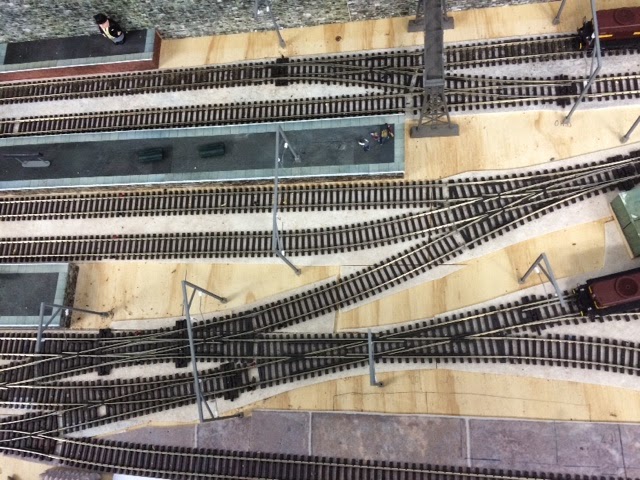
I did find that the wheel on the leading bogie was a bit narrow. Not by much but enough to make it derail on some of my older Peco points. I adjusted the wheel using a wheel gauge and gave the blades on some of the points a gentle squeeze to bring them in a bit more. Over the years these standards and construction of the points have changed and even though I still use code 100 the difference between new points and points which are fifteen years or more older is fairly noticeable. The last post which I made can show the difference between an old double slip from last century and a new double slip from last year.

It was with the former that I had the most difficulty, especially when going backwards. It appears that the tender doesn't have enough weight in it. When running backwards, the bogie next to the loco derailed. I adjusted the wheels using the wheel gauge but to no avail. When running backwards trough the vital piece of trackwork this bogie kept coming of and shorting the Digitrax Zephr. It wasn't long before the red LED in the tender for the marker lights refused to work.

From what I was able to conclude from observations on straights and flat track (Let's face it, that track was great when it was laid two years ago but expansion and contraction aren't a railway modeller's friends.) when running backwards it appears that the bar between the loco and the tender pushes the front of the tender up. Both bogies are sprung and that can cause a little wobble but the spring doesn't seem to be strong enough to push the bogie onto he track. I stopped the loco from revers on the test track and the bogie next to the loco was not sitting on the track and was easy to push off.
A thumping large nut did the trick but it's too big to fit in the tender. However, the loco and tender ran well through all of the trouble spots on the layout.

I messed about with a couple of sinkers and weights from other sources. In the end, as I had a strip of lead, I folded it to triple thickness and placed it into the area where the speaker will be fitted for the sound version. I cut one of the sinkers above in half and attached it to another strip of lead. The half sinker is placed between the plugs on the left and the e DCC chip with the strip of lead sitting above the chip. The lead is wrapped in electrical tape to avoid shorts and any weird corrosion that may occur. 

It is important to remember that the weight needs to be over the leading bogie, otherwise the bar will continue to push the front of the tender up and you will have the same problems.


I have now bought these weights from Hobbyland which should be easier to use next time. 

Saturday, 9 May 2015

Some Things Take a While

Today I picked up my second Trainorama 48 class loco, close to eight years after the order was placed. 

More importantly, I finally put numbers on my ballast hoppers. I bought a rake AR Kits BBW ballast hoppers when they were released sometime last century. I put them together quickly and painted them but for some reason I put numbers on all but three of them. I have no idea why the whole rake wasn't completed. The rest were weathered after numbering. 

After fitting a chip into the 48, I put numbers on the ballast hopper, however, they still need a bit of grime added to them. 


They also need a load of ballast to put on the tracks. 

I've also added another double slip between the station and the goods sidings. There was a crossing originally but this restricted access to the yard. Trains leaving or entering the yard (where the loco is in the picture below) could travel via the loop only. I thought that it would be operationally interesting which it was but it soon became to much of a challenge. At the time, I also didn't have two double slips. 


I took the opportunity to replace the medium right hand point as the old one was originally a second hand point which had some wear and tear and was causing some shunting difficulties with one of my locos. 

Now trains leaving the yard can run through the station using either the loop or platform five. 

Another job that has taken a while has been constructing the carriage shed. I'm building the shed from foam core board. The shed is half built for the moment but in place. Even in its half built state it protects the carriages within it. I reckon that a shell of thin cardboard and brick paper should finish the job. 

It could be a while yet before this job is complete to but in the meantime the car park behind the shed is done. 


Tuesday, 3 March 2015

Sunday, 4 January 2015

Park Life

Summer holidays are a great time for modelling. The track has been down for a while and trains have been running. It’s time to get a little more serious about the scenery. 

My idea is to start at one corner and work my way around the layout. The far left hand corner was the place to start. The plan was to make this area a botanical gardens or park. The park would be hosting sculpture display, a bit like Sculpture by the Sea. Up the back of the scene would be a mound with standing stones with druids. It may not be very Australian but I like standing stones and I have already messed about with historical reality in previous posts anyway. In July, I acquired a Faller kit of the Zeiss Planetarium in Jena, Germany, at a discounted price. It would look good in the corner.

Originally I thought that this corner of the layout would not be seen but after squeezing seven blokes into the shed one night for a running session, I would need to move an operator into the access hole near the park scene. This meant that this scene would need to be fairly decent. I also wanted the scene to be lit for night running, or night photography at least.

Lights and people were added to the planetarium during construction.
Strip LEDs (the type that you cut into strips of threes) were used to light the outside corridors of the planetarium.

The area still needs a few trees.
The area of the park was built up using polystyrene foam. The footpath was built up using foam core board overlaid with Scalescenes pavement. The walls are picture mounting board covered with Scalescenes stone prints. The road is Scalescenes tarmac. The standing stones were picked up from a gravel path and the druids are Prieser monks painted white (and given more hair.) The fire in the middle of the stones is from a LED tea light candle. The flame cover is still in place for now and I will need to add some sticks.

Druids gather around a fire in the centre of the standing stones. Records show that druids have been coming here for 4 000 years.
The scene is yet to be finished. It needs a bit more tweaking and some trees, which I have yet to make.

A dark sinister figure lurks under a lamp post on a cold winter night.

Monday, 22 December 2014

Newcastle Station

Today I caught the 7:36 to Central and the 9:15 to Newcastle. After Friday, I won't be able to do that again.

I didn't have my camera out at my local station as the train pulled in. It was a K set made up of original carriages with the low upstairs windows. The train to Newcastle was a refurbished V set with the purple interior.

On the way we passed an Aurizon freight, 1MB7, as it made its way up the Cowan Bank, this was followed by quad 82 class on a coal train and two Danish locos on a container train. Two 81 class locos were pottering about near Cardiff with wheat hoppers. At Broadmeadow Yard three CEY locos were in the sidings. On the way back CM3303, BRM001, CM3302 and BRM002 were at the head of what I think was CA05 in Broadmeadow Yard.

At Newcastle there were a number of other blokes taking photos while they still had the chance.

Here are a selection of photos from today and other times.


Sunday, 14 December 2014

A Bit of Train Spotting

I found a nice view not too far from home. There is a wattle tree in the way but it's not too bad. I heard that there was a heritage train coming through so I took my camera to watch it go past. I saw a couple of other trains too.


Sunday, 30 November 2014

A Long Time Between Drinks

Yep. It has been a while. I occasionally have some workmates around for drinks after work on a Friday afternoon. One of my mates was interested to see the progress that I had made on the layout as I was grabbing a beer. There wasn't any. It seems that from early August work seems to get a little busy and the progress on the layout seems to come to a halt. I haven't even had people around to operate the layout.

I did however, find the need to clean the layout up a little as my dad picked up a Hornby P2 with sound. It's not quite the south coast of New South Wales but the Cock o' the North looked great with a string of LNER coaches behind it.

The following week I received delivery of a couple 86 class locos. Fortunately the layout had already been dusted off.

I've always liked electric locos. Having grown up in the northern suburbs they were what I saw everyday on anything from interurban services to Gosford, the Newcastle Flyer and the the various country trains such as the Brisbane Limited and that's not to mention the endless goods trains which they hauled.

New arrivals to the layout.

These two are a little out of my brown era but they were a great looking loco and they are great looking models.

On the real railway, we had a couple of railmotor tours go through on the weekend. I took these in the morning.

621/721 at Asquith.

CPH 1, 3 and 7 at Mt Colah.